
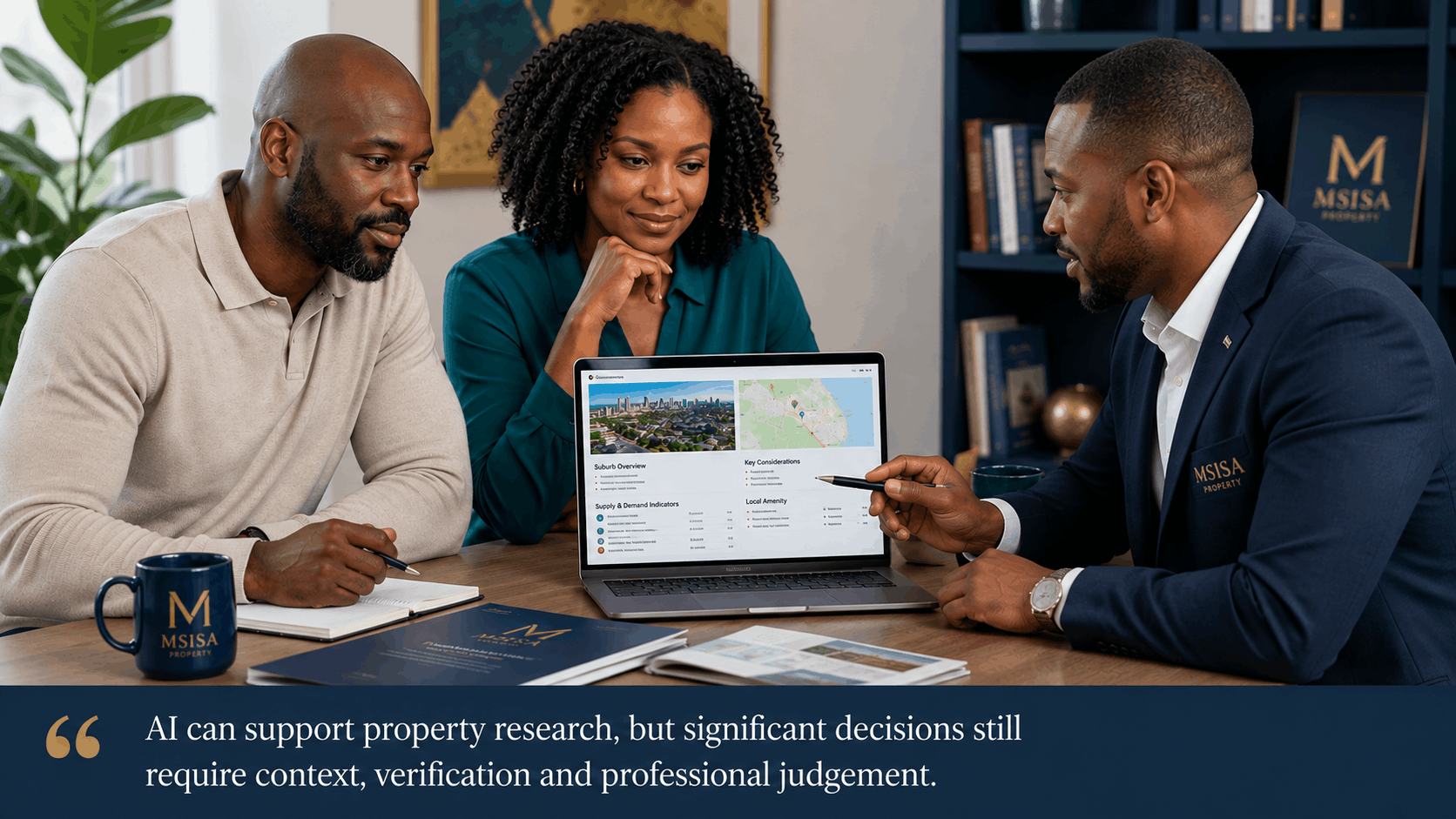
AI can inform your research, but strategy comes first
Artificial intelligence can answer a property question in seconds. The harder question is whether the answer is reliable enough to influence a decision that may shape your finances for decades.
More Australians are using artificial intelligence to build financial knowledge. Great Southern Bank’s 2026 No Place Like Home research found that 38% of Gen Z and 34% of Millennials use AI to inform financial decisions. Across all age groups, 27% said they use AI platforms for financial information.
That shift is understandable. Property research can be overwhelming. Buyers are trying to compare markets, borrowing capacity, rental income, risk, tax changes and long-term goals—often while working full-time and looking after a family. An AI tool can summarise unfamiliar concepts, generate questions and help someone begin.
But speed is not the same as suitability. The same Great Southern Bank research found that 69% of Australians consider guidance from mortgage brokers, financial advisers and banks more valuable than advice from AI. That is an important distinction: AI may help you become better informed, but it cannot automatically tell you whether a property decision is right for your circumstances.

The short answer
Use AI to improve the questions you ask—not to make the final property decision for you.
Where AI can genuinely help property buyers
- Used carefully, AI can make the early stages of property education more efficient. It is particularly useful for organising information and helping a buyer identify what they still need to investigate.
- Explain unfamiliar terms in plain language, such as rental yield, vacancy rate, usable equity or loan-to-value ratio.
- Create a starting checklist for a suburb, property inspection or due-diligence review.
- Compare general concepts, such as residential versus commercial property or growth versus income.
- Summarise documents you provide, while you check the summary against the original source.
- Generate questions to ask a buyer’s agent, mortgage broker, accountant, solicitor or financial adviser.
- Help organise your goals, concerns and assumptions before speaking with a professional.
This is where AI is at its best: accelerating learning and helping you prepare. A more informed client can ask sharper questions and participate more confidently in the decisions being made.
Where AI becomes risky
Property decisions are highly contextual. Two people can look at the same property and reach different conclusions because their incomes, debts, tax positions, timelines, borrowing capacity, family plans and tolerance for risk are different.
Public AI tools do not automatically know that context. Even when you provide background information, an answer may still be incomplete, outdated or confidently wrong. ASIC’s Moneysmart warns that AI tools can produce inaccurate or biased information and that relying on them alone—especially for investing—can lead to poor outcomes.
There is another risk: false information can appear credible because it is presented clearly. AI may blend sound principles with stale market data, incorrect legislation, invented statistics or assumptions that were never tested. A polished answer can feel authoritative even when its foundations are weak.
Five things AI cannot reliably decide for you
1. Your true borrowing position
A borrowing-capacity estimate depends on lender policies, verified income, existing debts, living expenses, credit limits, dependants and the proposed property. A mortgage broker or lender must test the real numbers.
2. Whether a property fits the purchase that follows
A property may look affordable today but reduce flexibility for the next acquisition. The right decision considers sequencing, buffers and the broader portfolio—not just whether one loan can be approved.
3. The quality of a specific property
Online data may not reveal building defects, problematic easements, flood exposure, planning constraints, unusual title conditions, oversupply risk or the quality of the immediate street. Desktop research must be supported by property-specific due diligence.
4. Your legal, tax or financial advice
AI can explain general concepts, but it should not replace advice from appropriately qualified professionals who understand your circumstances. Rules also change, so the date and authority of every material claim matter.
5. Your tolerance for uncertainty
An investment that looks logical on a spreadsheet may still be wrong if its vacancy risk, cash-flow pressure or holding period would cause you to abandon the strategy at the wrong time.
A safer way to use AI during property research
A useful discipline is to treat every AI answer as a draft hypothesis. It may point you towards something worth investigating, but it is not evidence until you verify it.
- Ask for the source, publication date and geographic relevance of every important factual claim.
- Open the original source. Do not rely on a citation that you have not checked.
- Prefer primary sources such as government departments, regulators, legislation, council planning documents and original research reports.
- Separate general education from personal recommendations. Ask: “What information about my position would be required before this conclusion could be reliable?”
- Request the strongest argument against the answer and list the assumptions that could make it wrong.
- Never upload unredacted identification, bank statements, tax records, trust deeds, contracts or other sensitive client documents to a public AI tool.
- Have the relevant professional verify any conclusion that could affect finance, tax, legal obligations, a contract or a significant purchase.
Questions worth asking before acting on an AI answer
- Is this information current in Australia and in the state where I plan to buy?
- What primary source supports the claim?
- Is the answer describing a general principle or making a recommendation for me?
- What facts about my financial position, goals and risk tolerance are missing?
- What could make this conclusion wrong?
- Which professional should verify this before I act?
Strategy still comes before property
The most useful property question is rarely “Which suburb should I buy in?” asked in isolation. A sound decision starts with your position and the outcome you want the portfolio to support. Only then can you decide whether the next acquisition should prioritise equity growth, income or a deliberate balance—and what risks should cause a property to be rejected.
At Msisa Property, research and technology support the process. They do not replace the human work of understanding the client, challenging assumptions, coordinating specialist input and testing each opportunity against a clear acquisition strategy.
The right next move is not always to buy immediately. It may be to strengthen finance, restructure, build a buffer, clarify the brief, wait for the right opportunity or decide that a proposed purchase does not fit. Good advice should create clarity—not manufacture urgency.
Ready to move from information to a property strategy?
If you are researching your next residential or commercial acquisition and want to understand what fits your finances, risk tolerance and long-term goals, start a conversation with Msisa Property.